Tuesday, December 20, 2022

Thursday, December 15, 2022
Social Media Join Us - Ombiology4u
Guji Calamadaha Social Media- Nagu Soo Biir - Ombiology4u- Join Us- 👇↧👇👇👇 👇👇👇


Tuesday, November 29, 2022
Slideshow htlm code embed sample

OMBIOLOGY4U
Hormood ka Caawiyaha Ardayda Dugsiyada Sare ee Somaliland - OMBIOLOGY4U.
Ombiology4u is the leading free educational website for Somaliland Secondary School Students.


Image Slidershow for Blogger
OMBIOLOGY4U - Hormoodka Kaabaha Ardayda Dugsiyada Sare ee Somaliland
Ombiology4u - Hoyga Casharada, Buugta iyo Imtixaanada Dugsiyada Sare ee Somaliland.
1 / 8

2 / 8

3 / 8
4 / 8
5 / 8
6 / 8
7 / 8
8 / 8

Monday, November 28, 2022
Sunday, November 27, 2022
Check exam 2
Question goes here.
Saturday, June 23, 2018
Circulatory System
Introduction:
Circulatory system is the system responsible for the body’s internal transport.There are two types of circulatory system in animals:
- Open circulatory system and
- Closed Circulatory system
- Open circulatory system is a type of circulatory system where its circulating fluid (hemolymph) bathes the cells directly; e.g. Arthropods
- Closed circulatory system is a type of circulatory system where blood circulates within closed blood vessels throughout the body; e.g. vertebrates
- Single Circulatory System and
- Double Circulatory System
- In single circulatory system, blood passes through the heart only once on each circuit around the whole of the blood circulation of the animal. For instance, fishes have single circulatory systems.
- In double circulatory system, blood passes through the heart twice during one complete circuit around the blood system through the body of the animal.
- Double circulatory system can be divided into:
- Pulmonary circulation
- Systematic circulation (systemic circulation)
- In pulmonary circulation, blood with carbon dioxide (deoxygenated blood) is pumped from the heart to the lungs while blood with oxygen (oxygenated blood) returns to the heart from the lungs.
- Pulmonary circulation is the circulation between the heart and the lungs.
- In systemic circulation, blood with oxygen (oxygenated blood) is pumped from the left side of the heart to all body parts while blood with carbon dioxide returns back to the right side of the heart.
- Systematic circulation is the circulation between the heart and rest of the body (other body parts)
Flowering Plants
Introduction to Flowering Plants
Flowering plants are plants that produce flowers
Flowering plants are vascular plants as they contain vascular tissues (both xylem and phloem)
Flowering plants are seeded plants as they produce seeds.
Flowering plants produce seeds enclosed with fruits.
Flowering plants are also called angiosperms.
Angiosperms are characterized by presence of roots, stems, leaves, flowers and fruits.
The underground part of the flowering plant is the root system while the portion above the ground forms the shoot system.
According to the type of seed they produce; flowering plants are classified into:
Flowering plants are also called angiosperms.
Angiosperms are characterized by presence of roots, stems, leaves, flowers and fruits.
The underground part of the flowering plant is the root system while the portion above the ground forms the shoot system.
 |
| Figure: Structure of a Flowering Plant |
According to the type of seed they produce; flowering plants are classified into:
- Dicot plants (dicotyledonous) and
- Monocot plants (monocotyledonous)
Dicot plants produce seeds with two cotyledons while monocot plants produce seeds with one cotyledon
 |
| Functions of the Root and Shoot System |
Leaves
Plant leaves are green in color as they contain green colored pigment called chlorophyll
Leaves are the photosynthetic organs for green plants.


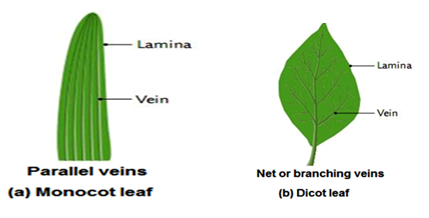 |
| Figure: Monocot and dicot leaves |
External Structure of a Leaf:
Internal Structure of a Leaf
When the leaf is cut in cross-section and seen under a microscope, the below structures are seen:
 |
| Figure: Internal structure of a Leaf |
Cuticle:
Cuticle is a transparent waxy layer covered on the upper surface of the leaf
Cuticle is made up of wax which is secreted by the epidermal cells
Functions of the Cuticle |
Cuticle allows light to pass into the leaf
Cuticle reduces water loss (acts as a waterproofing of the leaf)
Cuticle protects the leaf from drying out
|
Epidermis:
Epidermis is a single layer of cells on the upper and lower surface of the leaf.
The epidermal cells of the leaf don’t contain chloroplast.
Leaf epidermis keeps the leaf’s shape.
Epidermis of the leaf is divided into upper epidermis and lower epidermis
Upper epidermis:
Upper epidermis is found on the upper surface of the leaf and can be seen when the leaf is cut in cross-section and observed under microscope.
Cells of the upper epidermis are transparent
No stomata are present
Lower epidermis:
Lower epidermis is found on the lower surface of the leaf and can be seen when the leaf is cut in cross-section and observed under microscope.
Stomata are present
Upper epidermis:
Upper epidermis is found on the upper surface of the leaf and can be seen when the leaf is cut in cross-section and observed under microscope.
Cells of the upper epidermis are transparent
No stomata are present
Lower epidermis:
Lower epidermis is found on the lower surface of the leaf and can be seen when the leaf is cut in cross-section and observed under microscope.
Stomata are present
Functions of the Upper Epidermis of the Leaf |
|
Allows light to pass into the leaf
Acts as a barrier to micro-organisms
Secretes wax
|
|
Functions of the Lower Epidermis of
the Leaf
|
|
Acts as a protective layer
Site of gaseous exchange into and out of the leaf
|
Mesophyll tissue:
Mesophyll is the tissue between upper and lower epidermis of the leaf
Mesophyll tissue consists of:
- Palisade cells (palisade mesophyll cells) and
- Spongy cells (spongy mesophyll cells)
Subscribe to:
Posts (Atom)