” Welcome to Biology Notes for Learners; in this blog you will get valuable Biology lessons, Practical Biology Videos, Biology Exams, Biology Assignments and Motivational tips for all learners . Highly Thanks for being here!
Showing posts with label flowering plants. Show all posts

Saturday, June 23, 2018

Flowering Plants

Introduction to Flowering Plants

Flowering plants are plants that produce flowers
Flowering plants are vascular plants as they contain vascular tissues (both xylem and phloem) 
Flowering plants are seeded plants as they produce seeds.
Flowering plants produce seeds enclosed with fruits.
Flowering plants are also called angiosperms.
Angiosperms are characterized by presence of roots, stems, leaves, flowers and fruits.
The underground part of the flowering plant is the root system while the portion above the ground forms the shoot system.
Structure of a flowering plant consists of shoot and root system
Figure: Structure of a Flowering Plant

According to the type of seed they produce; flowering plants are classified into: 
  1. Dicot plants (dicotyledonous) and 
  2. Monocot plants (monocotyledonous) 
Dicot plants produce seeds with two cotyledons while monocot plants produce seeds with one cotyledon
The main common functions of the Shoot and Root System
Functions of the Root and Shoot System


Leaves

Plant leaves are green in color as they contain green colored pigment called chlorophyll
Leaves are the photosynthetic organs for green plants.

What are the functions of the leaf


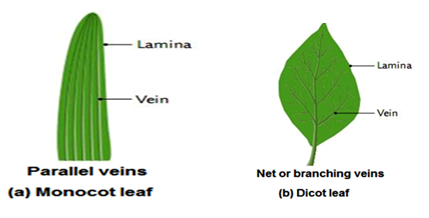
Structural differences between monocot and dicot leaves
Figure: Monocot and dicot leaves


External Structure of a Leaf:

Internal Structure of a Leaf


When the leaf is cut in cross-section and seen under a microscope, the below structures are seen:

Leaf anatomy
Figure: Internal structure of a Leaf


Cuticle: 

Cuticle is a transparent waxy layer covered on the upper surface of the leaf
Cuticle is made up of wax which is secreted by the epidermal cells


Functions of the Cuticle
      Cuticle allows light to pass into the leaf
      Cuticle reduces water loss (acts as a waterproofing of the leaf)
      Cuticle protects the leaf from drying out

Epidermis: 
Epidermis is a single layer of cells on the upper and lower surface of the leaf.
The epidermal cells of the leaf don’t contain chloroplast.
Leaf epidermis keeps the leaf’s shape.
Epidermis of the leaf is divided into upper epidermis and lower epidermis

Upper epidermis: 
Upper epidermis is found on the upper surface of the leaf and can be seen when the leaf is cut in cross-section and observed under microscope.
Cells of the upper epidermis are transparent
No stomata are present

Lower epidermis:
Lower epidermis is found on the lower surface of the leaf and can be seen when the leaf is cut in cross-section and observed under microscope.
Stomata are present


Functions of the Upper Epidermis of the Leaf

      Allows light to pass into the leaf
      Acts as a barrier to micro-organisms
      Secretes wax


Functions of the Lower Epidermis of the Leaf
      Acts as a protective layer
      Site of gaseous exchange into and out of the leaf


Mesophyll tissue: 
Mesophyll is the tissue between upper and lower epidermis of the leaf
Mesophyll tissue consists of:
  1. Palisade cells (palisade mesophyll cells) and 
  2. Spongy cells (spongy mesophyll cells)